Showing posts with label Travel. Show all posts

Wednesday, July 23, 2014

Footloose in Bundelkhand

Somewhere in Bundelkhand
Her precious jamuns

The grey tarred road stretched endlessly, breaking the monotony of rain washed green that dominated the landscape. We were in Bundelkhand, in central India, driving south from Khajuraho (story here), through the reserve forests, towards Jata Shankar temple. For many kilometers, ours was the only vehicle on the road. We were, once or twice, overtaken by a jeep or a bus, and sometimes we passed sleepy little villages in the forest clearing. These village houses were compact structures built on a single level, with flattened earth tile roof. The side walls of these houses were decorated with dried cow dung patties - fuel for a rainy day.

Caked in mud, herds of water buffalos strolled along the road without a care in the world, their brass bells tinkling as they shook their head or chewed on cud. Often we had to slow down and allow them right of way. In muddy rain created pools, few others lay neck deep, making the most of the spa-like mud bath. Sometimes we passed agricultural lands that stretched on for as far as the eye could see, and whole families worked together on the fields, building stick fences or tending to their produce. We stopped once to have a word, to ask what it was that they cultivated, and heard instead the story of the wandering cattle and the picky fowl that had ruined their hard day’s work. Further down the road, a boy sold jamuns, freshly plucked from those roadside trees growing on no-man’s land - a large packet for Rs 20.

Through the farms
Gowri and I were on a three-day trip to Khajuraho, but after a day of wandering around the temples in the scorching July sun, they all started to look alike. On day two, we wanted to do something else, and having found a friend in the old uncle running the Madras Coffee House, we asked him for suggestions. (Earlier in the day, we had hired an auto-rickshaw for a trip to Pandav falls, but fear got the better of us, and we returned half way. Full text here). For a nominal rate, he rented his white air-conditioned Swift Dezire and just to assure us that all will be well, promised to accompany us.

Though originally from Tamil Nadu, he had lived in these parts for over 65 years and had seen this society change from a feudal class dominated world ruled by kings to a place ripped up by dacoits and then to the more confused and fragmented society of today. He was a good storyteller, and in us, he found two avid listeners. He switched between Hindi and Tamil with ease, much like the characters of his stories – the past Kings of this region, the notorious Pooran Singh, MGR and the Pandava Vanavasam (story from the Mahabharata).

During their exile, the Pandavas are said to have lived in the forests of Bundhelkhand, and the stories of these wandering mendicants are deeply woven into popular folklore. A thirsty Draupadi asked Bhima to get her some water, and instead of looking for a water source, Bhima chose to crack the earth open with his mace, thus creating Bhimkund - a natural water tank, the depth of which is still unknown. 

Deep mysteries of Bhimkund

flight of slippery steps lead to this water body. It’s dark inside the cave, except for the small opening on the roof, where the mace is said to have fallen. The blueness of the skies is reflected in these deep waters, and its said to remain blue throughout the year - never a shade of mossy green or muddy brown. During the 2004 Tsunami, the water is said to have risen 30 meters high, like a wave, though the closest beach is a 1000 kms away.

Onwards to Jata Shankar
Little boys frolicked in the waters, showing of their swimming and diving skills. Few had tried to hold their breath till they hit the bottom of the pool, but none had ever succeeded. Towards the right, where the water is at its deepest, there is a channel, which connects it to a nearby river. Pilgrims pay homage at the small temple on the banks of the pond. I stepped forward to dip my feet, and the water felt extremely cold and was surprisingly clear.

From Bhimkund, we made our way towards Jata Shankar, another Hindu pilgrimage site, tucked away the deep forest. It was Amavasya, the day of the new moon. To a religious Hindu, it is a day of fasting and prayers, and Lord Siva is at the center of things. As we drove towards the temple, I noticed that many pilgrims were walking in the same direction. Men, woman and children walk for as long as 19 or 20 kilometers to offer their prayers at this cave temple, where stalagmite formations rise up to form the Shiva Linga. Makeshift shops decorated the sidewalks leading to the temple, and here we had a light meal of watery dal, rotis and tea. As the main pooja was only later in the night, we decided to head back.

Footloose in Bundelkhand
All through my journey never once did I cross a hospital or a small clinic. Not once did I see the large gates of a school, the kind that you are used to seeing while traveling across India. Public transport is next to nil in these regions and connectivity bad. Even if a bus does come by, there are people hanging from the roof, restricting travel plans. I also noticed, vast expanse of land, some ploughed and farmed, others bare and forsaken. This region has been in the news for all the wrong reasons - infant mortality, lack of education and hygiene and a high number of people falling in the Below Poverty Line category. 

Traveling through this region, it became evident that Bundelkhand has been largely ignored by the state, and their demand for a separate state is justified. But at the same time, in a class dominated society like this one, how much progress and sustainable development will any ruling class be willing to bring?

Back in Khajuraho, a mini mela had sprung up to cater to the Amavasya rush. An old man displayed his wares - glass bangles, kajal, kunkum, combs, clips… another had a collection of colourful wind wheels, balloons and whistles. There was puffed rice, jaggery and sugarcane in another corner – offerings to the Gods. Wearing bright orange, pink and blue glittery saris woman made their way through the crowd towards the peepal tree. They tied a thread around it and circled it 101 times - prayers send out to the universe for a better tomorrow.

Amavasya mela 

Khajuraho’s main income comes from tourism, but during off season, life rewinds into flashback mode. Town folks worship at the ancient Siva shrine, and continue to pledge their loyalty to the Maharajah. He is and has always been their protector. The echoes of the past are at its loudest during off season. Here, myths, folklore and epics converge, diversify and diverge.


Sunday, June 15, 2014

A Turtle Walk to Remember

Walking to Life

Isn't it strange how sometimes you forget about certain life changing experiences until something happens and stirs up that Pensieve? (You guessed it, I love Potter books). While I was in Trissur last week, I paid a visit to my husband’s ancestral home. In its current state of abandon, the house and its grounds are overrun with weeds. We made our way through the thickest, my father-in-law and I, searching for fallen coconuts. The grounds are notoriously dangerous, especially after the rains, and our search took us towards the unused pond. There, on its sandy banks my father-in-law spotted something that looked like a dry coconut husk. It was the shell of a tortoise – hard, grey and empty. I wondered how the animal had died. Did someone kill it for its meat or did it die a natural death at a ripe old age. I know they live to be a 100, sometimes even more. 

Way back in 2008, when I was still living in Chennai, I had gone on a Turtle Walk with some of my colleagues and a bunch of conservationists. I remember the date clearly; it was after 10  pm on February 29th, the leap year day. And it was something that I had wanted to do for a long time, ever since my college buddy Koshy described his walk experience.

Team dinner, group meet and turtles
I was with my team mates Bijoy Bharathan and Jonathan and the three member business reporting gang, Anandan sir, Sangeetha and Chirathan. 

The office cab dropped us off at Neelankarai, where we met Arun, from the Students' Sea Turtle Conservation Network - a voluntary group, working along the beaches of Chennai, trying to conserve and create awareness about Olive Ridley sea turtles. From stray dogs that feed on them, to greedy fisher folks looking for free omelet eggs, to propellers that mow down the swimming turtles; for these yearly visitors looking for a safe place to lay eggs, enemies were aplenty. The group was making great progress with locals in these areas, but even then they had ahead of them a challenging job. 

At about 11 pm, the group was fully formed - scouts or trained turtle spotters, regular walkers and a few first timers like us. Arun briefed us about what the night might have in store. We were to walk along the coast from Neelankarai beach to Besant Nagar (6.5 km stretch) and the journey was to be completed by 5 am the next morning. We were warned against using harsh lights or taking too loudly, as these might scare away the nesting turtle. “I cannot guarantee that you will see any turtles,” Arun said, making my heart sink.

Soon we set off in groups of six, with flashlights and the faint moon guiding us on. I remember thinking that sea was at its loudest and quickly realizing that this is probable because it was past midnight, and the streets were silent. Soon someone spotted something and we quickened our pace. 

Nesting time
A turtle had come to nest. Sand flew from under her hind legs as she laboriously worked the soil away, digging a pit deep and just right enough for her eggs. We gathered around, but the mother seemed oblivious to the attention that she was getting or she probably just wanted to lay those eggs. Her digging complete, she quickly moved on to the task in hand. We saw the eggs drop, one at a time, in rapid succession. Around 70 of them, I counted. 

While a camera managed to capture most of the action on night mode, the turtle, relived at last, started its next task. Once again sand flew all around, as she used her hind legs to cover up the pit and then used the weight of her body to pat down the sand and camouflage her nesting site. The sound of the waves guided her back to the sea, and in less than an hours, she had come, laid her eggs and vanished into the night. 

The team from the conservation network got down to business. They had to collect the eggs and also check the temperature and depth of the pit to rebuilt a similar one in the hatchery. There the eggs would stay, protected till the day they would hatch. On the way to the hatchery, the scouts spotted another turtle nesting site. The same process was repeated and more eggs bagged. 

Further down the beach, we spotted two dead turtles and a dolphin. I remember thinking that this was my first dolphin sighting as well. The feasting stray dogs stood silent and still until we passed the carcass.

Marching to the sea
Dawn was slowly breaking. I could see the sun as a faint orange line in a distance. We were approaching the fag end of our long walk and I was trailing behind. The magic of day break keeping me away from the walkers. What an exciting night it had turned out to be... but it wasn't over just yet, because the scouts ahead were waving once again. 

A set of eggs in the safe house was hatching. The little ones were crawling out of their egg shells and taking baby steps towards the ocean. The tide, the waves and the magnetic field were all guiding them on, and like troupes returning home from battle, they stomped towards the finish line. I picked one up and like a new born baby she wriggled (and was probably crying loud too). I was afraid that I’d drop her or hurt her, so I gently put her down near the sea, and she paddled away, riding high on the morning waves… a blob in a distance that soon vanished. 

For travelers heading to Chennai, looking for adventures that's outside the guide books, the Students' Sea Turtle Conservation Network could be a good start. In one single night I had witnessed birth, survival and death. For planning that adventure I have Jonathan to thank. And the dead turtle from last week, for reminding me again about the Circle of Life, that moves us all. 


Thursday, June 12, 2014

Partners in Crime (read Travel)

My world on my shoulders
I have noticed that people are far more receptive of me when I’m traveling alone. Some want to know why I do it others pick my brain about travel experiences and always conversation and food flows and before long we part friends.

But I’m not always a single woman traveler. I enjoy company on the roads and I’m blessed with two fabulously different and unique travel companions. Between the two of them, they ensure that I have a great time and solid memories to fill up my backpack.

My partner Sajeev, is a busy corporate guy, whose idea of travel is associated with the words ‘break’ or ‘vacation’. Timeline, USP (unique selling proposition), constraints, value add and EOD (End of Day) are terms that come into play when we plan our travels together. Like all business heads, he likes to delegate, which means I end up doing all the planning, researching and booking, but within the framework of the above mentioned keywords. 

Corporate busy-bee
This I enjoy, because it allows me to design our trips in a manner that works for the both of us. For him the luxuries of a comfortable bed, relaxation massages and fine dining; for me, some local cuisine and interactions, neighborhood markets and breathtaking moments. It is a sort of middle path, that combines the 'holiday' with the 'travel' experience.

None of these rules apply when I’m traveling with my bestie. Gowri is a cinematographer turned social ad film maker, who like me, believes that having no plan is the best plan. This is also because experience has taught us that when the two of us plan things to the T, nothing ever works out. So we simply decide on a date, and pack our cases, and let the road lead us. Sometimes we get into trouble and then rely on common sense or friends to bail us out. But after what can only be termed as the worst experience ever (link here), we have learnt to travel more cautiously.

Gowri's photograph in print: ET-TRAVEL

Ultimately I believe that it doesn’t matter how you travel, so long as the means has justified the end. This is a travel blog, but sometimes I digress and talk about people or food or an experience or an observation because travel is not just about going to places and dotting the map. It’s those things that you discover, that makes every trip worth taking. 

One final thought. Sometimes the best travel stories can come from our own backyard (meaning city or town), and I promise to be on the lookout for those kinds too. 

15 Things You Didn't Know About Me


The other day a reader wrote me saying there is very little information on my blog about the person I am. I thought long and hard about that, but a smart answer eluded me. So instead I took the easy way out, and drew up a list – 15 things you didn't know about me.


Will this do?

1. First and the most obvious. I'm a list maniac. Packing list, To-do list, Grocery list, Birthday list… I make lists. I simply can’t function without them. Could also be that I have the memory of a gold fish. This naturally brings me to the second item on the list.


My phone cam pic
2. Its not personal, but I’m bad with names – horrible, terrible with names. But good with faces and places.

3. I met His Holiness the Dalai Lama's in Jaipur during JLF'13. Covered his press conference and sat a mere 5 ft away. Yes, he was inspirational. And patient enough to indulge all of us. Someone even asked him about his Masterchef Australia appearanceIf I manage to find the audio recording from that interview, I promise to make a post of it. (Meanwhile, you can read about my tete-a-tete with the Australian Masterchefs here)

4. Starting over in a new place is a real challenge. It tells you what your chances really are. I've done that. TWICE! 

5. I didn't have a passport for the first 24 years of my life.

6. When people presume I don’t have the stamina to do certain things, it pisses me off. Yes I’m a woman and I’m not skinny, but hey I’m not dead either.

7. I got inked in Malaysia this year, but I took five years to conquer my fear of the needle. No, it doesn't hurt bad. The noise of the machine is scarier. That’s why Apple invented the iPod.


Yup, its a selfie no doubt
8. I got lost in Turkey, while traveling there on work (full story here). Was rescued and dropped off safe by a policeman in his official car, rotating lights and all.  

9. I’m perfecting the art of taking artful selfies.

10. I still get goosebumps thinking about my first camping experience. The raging storm nearly blew the tent away but I woke up to a magnificent sunrise at the foothills of the Himalayas. That blog post found here 

11. I was in the school band, played the trumpet. We didn't win the inter-school competition that year. 

12. Jughead is my comic book hero. And like him, I was christened ‘the bottomless pit’ in school. I grew up to become a food critique and connoisseur and have two successful food shows to my credit. It’s all there on my personal YouTube page.

13. I did theatre in college, studied English Literature and Communication, started my career in a Public Relations firm, crossed over to the other side and took up journalism.


No.. I can't.. no..nooo...

14. During takeoff, I close my eyes, hold my breath and my seat. Remember Meg Ryan in French Kiss?

15.  When I’m not traveling solo, my partner (busy corporate television person) Sajeev travels with me. At other times my bestie and genius photographer Gowri gives me company.


So this here is a list of things that might interest you about me. Or maybe not. Phew! I just found out how hard it is to make a selfie list. Have you made one already? Leave it in the comment section cos by now you know I love listings. 

Thursday, April 10, 2014

Beyond Khajuraho's Kama Sutra

July in Khajuraho
It finally arrived from the frame shop last week, a memory sealed within a 2" thick brown wood border. Today it hangs proudly in the front room, the amateurish stroke mistaken for mine by ignorant, visiting neighbours, who loose interest when I tell them it's tribal Gond Art from Madhya Pradesh. To them, it is inexpert colour, to me a small part of a beautiful memory.

Travel finds
Nine months have passed since that trip to Bundelkhand. The hills were unsafe after the floods they said, so towards the plains we (Gowri & I) moved. The trip was a special one,

because it was going to be our last before I shifted cities. We had learnt our lesson from our previous train travel, so this time around we traveled in style in the air conditioned coach. Its a 10-odd hour trip, and the next morning we woke up to the sight of lush green hills and endless plains.

In 'boar'ing company 


Our accommodation chosen after carefully reading the reviews on boooking.com was basic. We checked in, freshened up and set off to explore the temple town. Gowri wanted to travel by bike, but I wasn't very confident about staying on it, so we walked. The main temple cluster is on the Western side, and there are a few others on the Eastern and Southern parts. Of course if you travel in July, like we did, chances are that you wouldn't want to spend any more time than you absolutely have to, out in the sun.

The main tour begins at this gigantic 9-ft Varaha or boar temple - the third avatar of Vishnu. Carved out of a single stone, this beauty has 675 miniature figures carved on it, depicting the Gods of the Hindu pantheon. Though it was magnificent, we were dying to see the erotic sculptures. After all wasn't that what Khajuraho was all about? How wrong we were!

At the Lakshmana Temple, we caught sight of the first erotic carvings. The temple, had on its outer wall carvings that depicted all walks of life - a wedding procession, a war march, a musical setting, and among other things sex.

All kinds of it - couples, orgies, homosexual encounters... one look at the carvings and you'll know that there was a time, (between 950 and 1050 AD to be precise) when sex was spoken, written, carved and probably practiced with gay abandon, and therefore allowed on 'sacred' temple walls.

Lakshmana Temple

And here we are today, on the threshold of change and development, rewriting laws to make same sex marriages a criminal offence or imposing strict moral codes on ourselves based on gender, religion and community. I am going a little off track and sounding like an old tape recorder. Back to Khajuraho then.

After shower
Though sex is depicted on some temple walls, to brand Khajuraho as a Kama Sutra haven would be a crime. This temple town is an architectural masterpiece, each structure designed keeping in mind vastu rules and mythological specifications. The one dedicated to the Sun God faces the East, the one for Shiva has a smaller temple on the opposite side dedicated to Nandi. The 'garbhagraha' or the sanctum sanctorum has circular or square shaped roof depending on the deity in question.

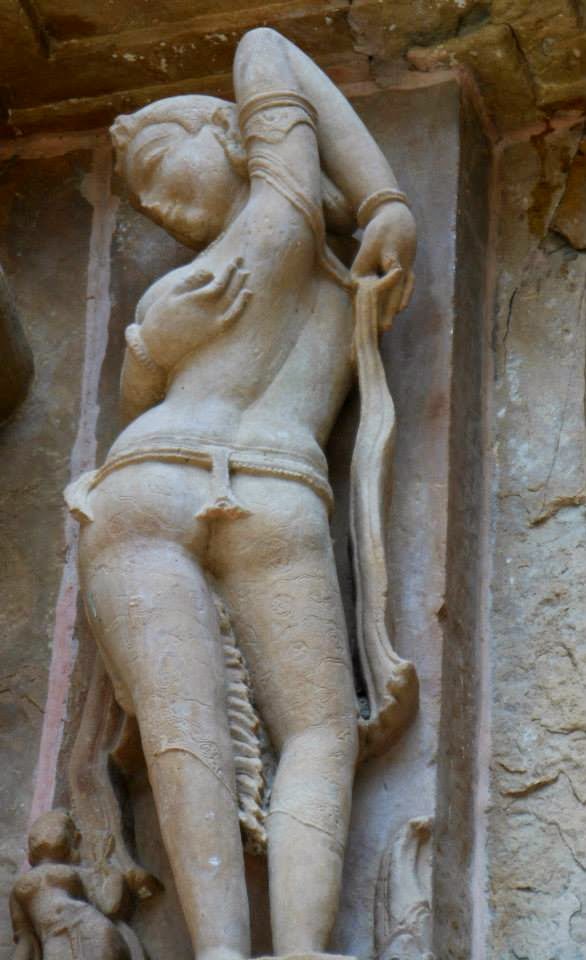
And the carvings.. my oh my.. the art work on each of these temples will blow your mind away! One work particularly caught my fancy. A woman is in a state of undress and the artist has captured the fall of her garment and the curve of her back as she stretches. The Kandariya Mahadev temple was like a poetry cast in stone. At 102-ft, the magnitude of its construction was visible in the recurring patterns and designs on sandstone. It was a bright sunny day, so after nearly four hours of heat and sweat and sun burn, we decided to call it a day.

Our plan was to explore the surrounding areas on day two. So off we went in a hired auto, past the temple town and the airport, in the direction of Panna National Park. As we left the main town behind, the landscape changed. Concrete houses made way for mud tiled ones and soon the thatched roof kind. Then even those vanished, and it was just us on the road, with dry, empty fields on either sides and an occasional grazing buffalo.

I could see that life in Khajuraho is not easy. Connectivity is a grave problem and so is education and development. For years now, strong voices of dissent has risen from Bundelkhand, seeking more funds and possibly a separate state. Post Telangana these voices have only grown louder. The auto stuttered on, and about 20-minutes later, a crowded bus precariously balancing its passengers and their possession on its roof, passed us in the opposite direction. I had seen something like this in the Fevicol advertisement, and had laughed at what I presumed was exaggeration.

Village scene

Now that the bus was gone, the road seemed endless and lonely and the two of us were worried for our own safety. According to the driver, we had traveled half way, but we decided to double back. Call us paranoid or call us cautious, but the loss of a few hundred rupees and half a day was a small price to pay for peace of mind, and probably safety.

Dots & Dashes
When the auto fellow dropped us off near the temple, I noticed a small shop where a man sat painting. Dilip Singh specialises in Gond and Rajasthani style of art, and was at that point working on a commissioned piece for a resort - colourful fishes on a yellow background painted using dots and dashes.

How we befriended him and convinced him to part with his painting is the second part of this story. In that post, I'll also included stories of our adventures across Chhatarpur district, at the often ignored Bhimkund and the pilgrimage site of Jatashakar.

Shiva & Nandi temples

Kandariya Mahadev Temple

Saturday, March 22, 2014

Comeback Season

"Hey, I'm back!.... Bringing you stories you've never heard..."  yes yes, my heart sings in true Karan Johar Broadway isthyle. If you don't get the reference, check the video.


I'm finally at my desk, writing a blog post after a gap of nearly 7-months. That's a really long writers block I had there.. But hey, a lot has happened and I just wasn't able to find my personal space and center.

To begin with, I quit my really exciting television job to follow my husband across the county, across seven states to be precise and a little more than 2500 Kms.

Still waters

We bought a countryside home, on the banks of an almost-always still flowing river. Sometimes I wonder if it's really there, and just then, as if to banish my fears, this bright blue kingfisher living on the nearby coconut tree, swoops down for his daily catch, upsetting the stillness to create green circular ripples. Or a lone boatman rows by. Silently.

We have called our place 'Prarthana' which means, a prayer
I was under the impression that when I finally traded the high pressure TV job to play full time missus and part time educator, voice over artist and stage show host (yeah I juggle well), I'd have more time to write.

How wrong was I!! A new house I discovered is like a just born, always crying for attention. The towel ring needs to be fixed, the door needs an extra latch, the tap needs a mesh, the fan needs fixing, and well... ufff.. the list could go on and on and on..

And if it wasn't the house, then it was one of the other jobs. A late night here, a voice test there, a meeting on one day and a seminar the next.

Plus, I have been entertaining. I really wasn't expecting to have so many friends over, but so far I've had Sydney, Chennai, Delhi, Kochi and Bangalore pay me a visit. And I'm waiting impatiently for the others to catch up.

My often ignored writing desk

It all looks rather busy, I know. But what I have also managed to do is keep my travel case packed all the time. At the slightest excuse, and sometimes with none, I have been on the road, meeting and making friends. Which also means, I have news to share, and this is just the start.

For now, I'll leave you with my first home pictures. The other stories will follow in random order.

Just around the corner, a road that makes me smile.

Wednesday, August 28, 2013

‘Indian men, bahut harami’

A slightly shorter version of this piece appeared in Azhimukham, an online journal in Malayalam early this week. For those of you who cannot read the language, here it is.


Jean-Baptiste-Camille Corot's Woman in Blue
“You mean you are not Slovenian? I thought you were, because you just don’t look Russian,” he said. The lady in the blue evening gown answered politely. “I am Russian.” He was quick with his next question. “And the man you were talking to earlier... are you friends? Is he from Russia too?” Yes, she said. He is from Russia, but he wasn't someone she knew personally. More questions followed. How long have you been in Delhi? 10 years is a long time, do you speak Hindi then? And where do you stay?

I was at a party and this conversation happened across the table. At first I wasn't paying any attention, but soon I was drawn into this game of cat and mouse. The woman was polite and kept her answers short. She had an exhausted smile. Short answers were good enough for the man who continued to grill her.

Soon he popped the inevitable question. “Can I have your number? I can meet you at Vasant Vihar near your place, and we can have a coffee or something.” A small pause, and he adds, “I’ll text you and if you don’t respond that will be the end of it. I won’t bother you.” She made a polite excuse, “I’m thirsty, I have to get something to drink.” He didn't get the hint and if he did, he wasn't ready to let her off the hook. Not after he had tried so hard, for so long. Let me bring it for you he said, before rushing off.

She looked at me with an exasperated expression. “Do you get this often?” I asked her. She nodded. In her 10 years of living in India, she had learnt that ignoring a man’s advances might hurt his ego. And that's just something you don’t want to do. It is instead best to play the role of a courteous ice maiden. “Indian men,” she said, “bahut harami.” Bahut was emphasized, and I don’t think that was because of her accent.

My evenings in KL
At a tourism seminar held in the city, I learnt that France is the most visited country in the world and closer home there is China, Malaysia and Hong Kong. India, according to the travel gurus, wasn't living up to it's true potential. In all these popular countries, apart from the infrastructure and sightseeing options, safety of a traveler is assured.

I landed in Kuala Lumpur (detailed travel account here) late one night in February and hailed a taxi to the city center. I was of course scared and therefore alert, but when the car stopped at the toll gate in the middle of nowhere, I noticed that the night staff was a woman. Her presence reassured me, and sure enough I had an uneventful ride into the city. I don’t think my country returns the same favour to women travelers. The lady in the blue evening gown is just one of the many 'atithis' or guests, who find living and traveling in India uncomfortable. In many places, including our biggest cities, we do not have enough public convenience spaces. The few that exist are dirty and unhygienic. So during the Commonwealth Games, when two women approached me with this question at Connaught Place, I took them to United Coffee House and explained their situation to a sympathetic manager.

Aurélie De Smedt has a special bond with India. She found the man of her dreams here. She has many friends and has traveled and lived in the remote corners of the country and therefore looks forward to her annual pilgrimage to the subcontinent. “But I can appreciate India only in parts,” she says, “Here; I cannot afford to let my guard down. I cannot relax on a bus or sit on a park bench without attracting unnecessary attention. My mind has to stay alert. I am always asking myself questions like - should I do this? Can I go there? Am I dressed right? It is all very exhausting. Back home I can relax and not worry about being attacked in broad daylight. But I look forward to my Indian vacations, though technically I relax only after I go back home.”

Nancy Mueller's Woman
Hungary’s Heléna Kontos couldn't agree more. “When I first moved to India, I was thrilled every time a man gave me a second look. In Hungary unless you are both sexy and 17, nobody gives a damn. But of course, this feeling didn't last for long. I soon realised that these weren't just admiring glances. Now, I wrap a shawl around me every time I step out and don’t go anywhere without my husband. I am an independent woman, but here in India I have to depend on so many people to get things done… my husband, the maid, the watchman… and that’s not a happy feeling,” she said.

I understand what she means. I grew up in Kerala where 'eve teasing' is as common as taking an oil bath. Most of us therefore, develop a sort of sixth sense about these things, and learn to foresee and avoid them.

Of course, I must also add that I'm not generalizing India as this big, bad, mean place full of clawing men. When I moved to Madras in 2005, I had a tough time adjusting. My sixth sense was useless here. No one gave me a second glance, and there certainly was no eve teasing. For a while I wondered if this was because I was unattractive. As an young girl of 21, I rated myself based on how much the world 'admired' me. I soon figured out that Tamil men respected their women folks. They call her 'amma' or mother, and therefore, even on a crowded bus, she is safe. Of course it is a conservative society, but its conservative nature allows a women to be. In fact, I would even go to the extend of calling it a gender neutral society, and it was here that I felt truly liberated.

Sadly, I can't say the same about the capital. It was a rainy day and Heléna had an open umbrella in her hand. She was shopping at Sarojini Nagar market, when a strong hand grabbed her unshielded breast. Another time, she was on a train with her visiting family, traveling between Kerala and Goa. Sometime in the night her cousin sitting on the lower berth, felt something warm and slimy on the nape of her neck. It was falling from the upper berth. Something white, almost translucent. When she realised what it was, she was too shocked to react.

When these women return to their countries, they might not recollect in great detail the lush green landscape, the big fat Indian weddings, the flavourful meals and the colourful ceremonies that they were a part of. But these experiences - the feeling of helpless outrage, shock and disgust, they will always remember.

Bikas Das's busy streets of Kolkata, India
Thomson Reuters Foundation did a survey in June 2011, which placed India 4th in the list of the world's most dangerous countries for women. The survey predates the much publicized Delhi gang rape case of 2012, or the more recent rape of a photojournalist in Mumbai.

Image for reference only
The rupee is plummeting; and we need foreign travelers to spend their dollars and pounds here. In many ways, our world is slowly waking up to this reality. In a first of its kind initiative, the Government of Tamil Nadu has announced auto rickshaws with GPS systems and a panic button.We now have hotels like The Leela reserving an entire floor for single women travelers. The tourism ministry has also launched an 'I Respect Women' campaign.

Today, more than ever, we need to reinvent ourselves and our image to make the ‘Incredible India’ campaign work for us. We should also learn to recognise women as fellow human beings well worthy of our respect. 

Friday, August 2, 2013

For Now, Just This


Untold stories, unwritten dramas.. 
there is so much that I have to share, 
but for now, just this travel thought. 
 
Blog updated will soon follow. 


For now, just this

Tuesday, May 21, 2013

The Scarlet Pimpernels of the Mountains


A bunch for Rs 10

I was in Mussoorie two weeks ago, and the timing couldn't have been more perfect. As luck would have it, I managed to witness the last of the rhododendron in bloom. A week too late, and I would have missed this wonderful phenomenon, though at that time I knew nothing about either of them. But I am getting ahead of the story here; so let me put things in perspective.


Thoughtful @Happy Valley, temple in the background
We drove from Delhi to Mussoorie, my friends and I. After long hours on the road without any incidents, if you don’t count occasional arguments, over eating and back seat driving, we were at Mussoorie. The trip was unplanned and we didn't have a reservation, which meant we drove for a while trying to figure out a place to stay. We eventually checked into a  decent hotel and our chaperone and acting chauffeur Anurag, decided to take a nap. So the two of us, Gowri Sundararajan and I, partners in crime, decided to explore Mussoorie on our own.


Last of spring at Rusty's Mussoorie 
I grew up with Ruskin Bond’s books, and to travel to Rusty’s town was almost like a dream come true. On rainy days in Kerala, book in hand, I used to wonder what spring would look like on the mountains of Mussoorie and Doon. In my mind’s eye, I imagined wild violet flowers growing from the cracks between the walls and small white flowers blooming all along the forest trail, just like the writer said they would. Walking away from the town towards Happy Valley, which has India’s first Tibetan temple (Shedup Choephelling), I noticed that spring was everywhere - in the air, in the mountain cracks, on rotting tree trunks and on tall trees. Photographing these flowers almost became an obsession. 

But it was en route to Dhanaulti, that I noticed wild red flowers growing on tall trees along the steep mountain side. Tucked between dark green coniferous trees, the flaming reds of these flowers looked like mountain fire. As the roads coiled and curved, I strained my neck for a better view.

A 25-km drive can take close to two hours on the mountain roads. Worried that we might be on the wrong track we stopped and asked for directions at an intersection. There, in a small shop facing a scenic mountain drop, I noticed rows of scarlet bottles with pictures of the now familiar flower. That’s how I found out about rhododendrons, locally known as Burans. Interestingly, these red rhododendrons are Nepal’s national flower and closer home in Uttarakhand they are recognised as the state tree and the locals consider it a gift from the Gods, with divine powers. It is said to be good for the heart and the liver and is also used in treating diseases like asthma and high blood pressure. Traditionally, house guests are greeted with a glass of homemade burans juice. Chutneys and pickles made from this flower are local delicacies.

Scarlet blooms

According to the annual report (2009-10) published by the Uttarakhand Forestry Research Institute (Haldwani) burans is a tough crop to grow; because the seedling survival of this variety is only 10-12 per cent. Put this alongside the ratio of deforestation for fire wood, and things don’t look good for these scarlets. But an increasing awareness about its uses and the international market gravitating towards organically prepared burans juice, this tree named in the Guinness World Records as the largest rhododendron, might still stand a chance.

Back in Delhi, I ration my burans juice intake; because I have just two bottles and I need them to last through the summer. It is a refreshing drink with a strong scent of rose water, which is used in the preparation of the concentrate. The one I bought has sugar mixed in, so between the sweetness and the scent of roses, I’m not sure what the burans really taste like. The shop keeper told me that the petals are sour but the sac has sweet nectar. I also know that for the people of Uttarakhand it is nature’s greatest gift - one that plays a central role in their everyday lives while also sustaining their forest's ecosystem.


A summer drink

Partners in crime at one of the many winding roads

Wild white roses
With my 'chaperone'