Showing posts with label women travelers. Show all posts

Wednesday, July 23, 2014

Footloose in Bundelkhand

Somewhere in Bundelkhand
Her precious jamuns

The grey tarred road stretched endlessly, breaking the monotony of rain washed green that dominated the landscape. We were in Bundelkhand, in central India, driving south from Khajuraho (story here), through the reserve forests, towards Jata Shankar temple. For many kilometers, ours was the only vehicle on the road. We were, once or twice, overtaken by a jeep or a bus, and sometimes we passed sleepy little villages in the forest clearing. These village houses were compact structures built on a single level, with flattened earth tile roof. The side walls of these houses were decorated with dried cow dung patties - fuel for a rainy day.

Caked in mud, herds of water buffalos strolled along the road without a care in the world, their brass bells tinkling as they shook their head or chewed on cud. Often we had to slow down and allow them right of way. In muddy rain created pools, few others lay neck deep, making the most of the spa-like mud bath. Sometimes we passed agricultural lands that stretched on for as far as the eye could see, and whole families worked together on the fields, building stick fences or tending to their produce. We stopped once to have a word, to ask what it was that they cultivated, and heard instead the story of the wandering cattle and the picky fowl that had ruined their hard day’s work. Further down the road, a boy sold jamuns, freshly plucked from those roadside trees growing on no-man’s land - a large packet for Rs 20.

Through the farms
Gowri and I were on a three-day trip to Khajuraho, but after a day of wandering around the temples in the scorching July sun, they all started to look alike. On day two, we wanted to do something else, and having found a friend in the old uncle running the Madras Coffee House, we asked him for suggestions. (Earlier in the day, we had hired an auto-rickshaw for a trip to Pandav falls, but fear got the better of us, and we returned half way. Full text here). For a nominal rate, he rented his white air-conditioned Swift Dezire and just to assure us that all will be well, promised to accompany us.

Though originally from Tamil Nadu, he had lived in these parts for over 65 years and had seen this society change from a feudal class dominated world ruled by kings to a place ripped up by dacoits and then to the more confused and fragmented society of today. He was a good storyteller, and in us, he found two avid listeners. He switched between Hindi and Tamil with ease, much like the characters of his stories – the past Kings of this region, the notorious Pooran Singh, MGR and the Pandava Vanavasam (story from the Mahabharata).

During their exile, the Pandavas are said to have lived in the forests of Bundhelkhand, and the stories of these wandering mendicants are deeply woven into popular folklore. A thirsty Draupadi asked Bhima to get her some water, and instead of looking for a water source, Bhima chose to crack the earth open with his mace, thus creating Bhimkund - a natural water tank, the depth of which is still unknown. 

Deep mysteries of Bhimkund

A flight of slippery steps lead to this water body. It’s dark inside the cave, except for the small opening on the roof, where the mace is said to have fallen. The blueness of the skies is reflected in these deep waters, and its said to remain blue throughout the year - never a shade of mossy green or muddy brown. During the 2004 Tsunami, the water is said to have risen 30 meters high, like a wave, though the closest beach is a 1000 kms away.

Onwards to Jata Shankar
Little boys frolicked in the waters, showing of their swimming and diving skills. Few had tried to hold their breath till they hit the bottom of the pool, but none had ever succeeded. Towards the right, where the water is at its deepest, there is a channel, which connects it to a nearby river. Pilgrims pay homage at the small temple on the banks of the pond. I stepped forward to dip my feet, and the water felt extremely cold and was surprisingly clear.

From Bhimkund, we made our way towards Jata Shankar, another Hindu pilgrimage site, tucked away the deep forest. It was Amavasya, the day of the new moon. To a religious Hindu, it is a day of fasting and prayers, and Lord Siva is at the center of things. As we drove towards the temple, I noticed that many pilgrims were walking in the same direction. Men, woman and children walk for as long as 19 or 20 kilometers to offer their prayers at this cave temple, where stalagmite formations rise up to form the Shiva Linga. Makeshift shops decorated the sidewalks leading to the temple, and here we had a light meal of watery dal, rotis and tea. As the main pooja was only later in the night, we decided to head back.

Footloose in Bundelkhand
All through my journey never once did I cross a hospital or a small clinic. Not once did I see the large gates of a school, the kind that you are used to seeing while traveling across India. Public transport is next to nil in these regions and connectivity bad. Even if a bus does come by, there are people hanging from the roof, restricting travel plans. I also noticed, vast expanse of land, some ploughed and farmed, others bare and forsaken. This region has been in the news for all the wrong reasons - infant mortality, lack of education and hygiene and a high number of people falling in the Below Poverty Line category. 

Traveling through this region, it became evident that Bundelkhand has been largely ignored by the state, and their demand for a separate state is justified. But at the same time, in a class dominated society like this one, how much progress and sustainable development will any ruling class be willing to bring?

Back in Khajuraho, a mini mela had sprung up to cater to the Amavasya rush. An old man displayed his wares - glass bangles, kajal, kunkum, combs, clips… another had a collection of colourful wind wheels, balloons and whistles. There was puffed rice, jaggery and sugarcane in another corner – offerings to the Gods. Wearing bright orange, pink and blue glittery saris woman made their way through the crowd towards the peepal tree. They tied a thread around it and circled it 101 times - prayers send out to the universe for a better tomorrow.

Amavasya mela 

Khajuraho’s main income comes from tourism, but during off season, life rewinds into flashback mode. Town folks worship at the ancient Siva shrine, and continue to pledge their loyalty to the Maharajah. He is and has always been their protector. The echoes of the past are at its loudest during off season. Here, myths, folklore and epics converge, diversify and diverge.


Thursday, April 10, 2014

Beyond Khajuraho's Kama Sutra

July in Khajuraho
It finally arrived from the frame shop last week, a memory sealed within a 2" thick brown wood border. Today it hangs proudly in the front room, the amateurish stroke mistaken for mine by ignorant, visiting neighbours, who loose interest when I tell them it's tribal Gond Art from Madhya Pradesh. To them, it is inexpert colour, to me a small part of a beautiful memory.

Travel finds
Nine months have passed since that trip to Bundelkhand. The hills were unsafe after the floods they said, so towards the plains we (Gowri & I) moved. The trip was a special one,

because it was going to be our last before I shifted cities. We had learnt our lesson from our previous train travel, so this time around we traveled in style in the air conditioned coach. Its a 10-odd hour trip, and the next morning we woke up to the sight of lush green hills and endless plains.

In 'boar'ing company 


Our accommodation chosen after carefully reading the reviews on boooking.com was basic. We checked in, freshened up and set off to explore the temple town. Gowri wanted to travel by bike, but I wasn't very confident about staying on it, so we walked. The main temple cluster is on the Western side, and there are a few others on the Eastern and Southern parts. Of course if you travel in July, like we did, chances are that you wouldn't want to spend any more time than you absolutely have to, out in the sun.

The main tour begins at this gigantic 9-ft Varaha or boar temple - the third avatar of Vishnu. Carved out of a single stone, this beauty has 675 miniature figures carved on it, depicting the Gods of the Hindu pantheon. Though it was magnificent, we were dying to see the erotic sculptures. After all wasn't that what Khajuraho was all about? How wrong we were!

At the Lakshmana Temple, we caught sight of the first erotic carvings. The temple, had on its outer wall carvings that depicted all walks of life - a wedding procession, a war march, a musical setting, and among other things sex.

All kinds of it - couples, orgies, homosexual encounters... one look at the carvings and you'll know that there was a time, (between 950 and 1050 AD to be precise) when sex was spoken, written, carved and probably practiced with gay abandon, and therefore allowed on 'sacred' temple walls.

Lakshmana Temple

And here we are today, on the threshold of change and development, rewriting laws to make same sex marriages a criminal offence or imposing strict moral codes on ourselves based on gender, religion and community. I am going a little off track and sounding like an old tape recorder. Back to Khajuraho then.

After shower
Though sex is depicted on some temple walls, to brand Khajuraho as a Kama Sutra haven would be a crime. This temple town is an architectural masterpiece, each structure designed keeping in mind vastu rules and mythological specifications. The one dedicated to the Sun God faces the East, the one for Shiva has a smaller temple on the opposite side dedicated to Nandi. The 'garbhagraha' or the sanctum sanctorum has circular or square shaped roof depending on the deity in question.

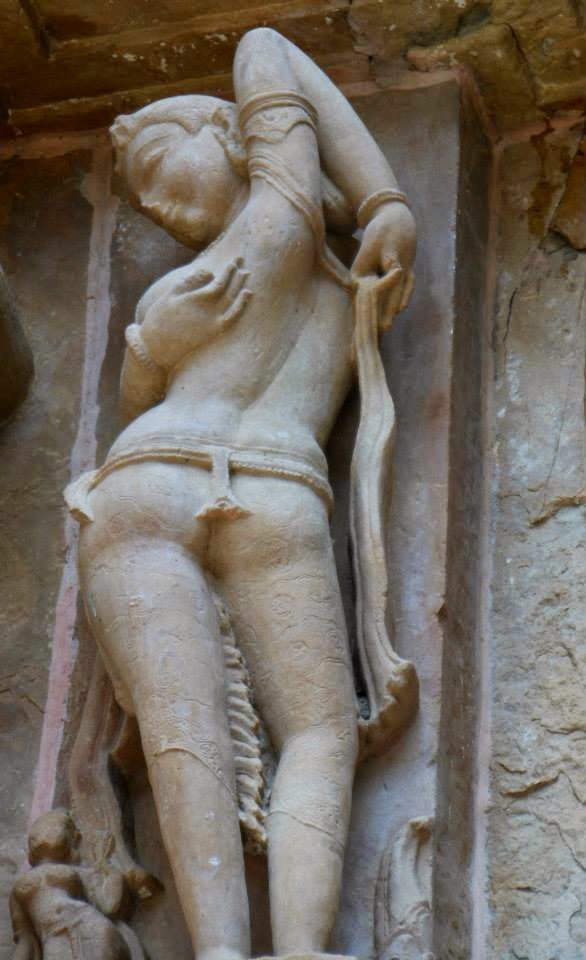
And the carvings.. my oh my.. the art work on each of these temples will blow your mind away! One work particularly caught my fancy. A woman is in a state of undress and the artist has captured the fall of her garment and the curve of her back as she stretches. The Kandariya Mahadev temple was like a poetry cast in stone. At 102-ft, the magnitude of its construction was visible in the recurring patterns and designs on sandstone. It was a bright sunny day, so after nearly four hours of heat and sweat and sun burn, we decided to call it a day.

Our plan was to explore the surrounding areas on day two. So off we went in a hired auto, past the temple town and the airport, in the direction of Panna National Park. As we left the main town behind, the landscape changed. Concrete houses made way for mud tiled ones and soon the thatched roof kind. Then even those vanished, and it was just us on the road, with dry, empty fields on either sides and an occasional grazing buffalo.

I could see that life in Khajuraho is not easy. Connectivity is a grave problem and so is education and development. For years now, strong voices of dissent has risen from Bundelkhand, seeking more funds and possibly a separate state. Post Telangana these voices have only grown louder. The auto stuttered on, and about 20-minutes later, a crowded bus precariously balancing its passengers and their possession on its roof, passed us in the opposite direction. I had seen something like this in the Fevicol advertisement, and had laughed at what I presumed was exaggeration.

Village scene

Now that the bus was gone, the road seemed endless and lonely and the two of us were worried for our own safety. According to the driver, we had traveled half way, but we decided to double back. Call us paranoid or call us cautious, but the loss of a few hundred rupees and half a day was a small price to pay for peace of mind, and probably safety.

Dots & Dashes
When the auto fellow dropped us off near the temple, I noticed a small shop where a man sat painting. Dilip Singh specialises in Gond and Rajasthani style of art, and was at that point working on a commissioned piece for a resort - colourful fishes on a yellow background painted using dots and dashes.

How we befriended him and convinced him to part with his painting is the second part of this story. In that post, I'll also included stories of our adventures across Chhatarpur district, at the often ignored Bhimkund and the pilgrimage site of Jatashakar.

Shiva & Nandi temples

Kandariya Mahadev Temple

Wednesday, July 17, 2013

The Journey that Scarred us for Life

Find our Triund adventures here
Around this time last year, Gowri and I, still reeling from our Triund adventure, decided to pack our bags again. Archana had gone back to Chennai, so the two of us decided to travel to Rishikesh over the weekend. We planned to take a train to Haridwar and then a bus to Rishikesh. We didn't make it there. But that journey, which ended as quickly as it began, scarred us for life.

Our special train to Haridwar was from Delhi station. After a 45 minute delay, the still empty train, made its way to Shahdara, the next station. Within seconds, our reserved 72-seater coach was invaded by a saffron-clad humanity. If I’m allowed to say so, the train was ‘overflowing’ with people - they stood at the doors, hung precariously outside with their hands tightly wound around the window bars and squeezed into the smelly toilets. Every seat had a minimum or three travelers and Gowri’s lower berth was also invaded. Some huddled at her feet and others found space at the edge of her seat.

Saffron clad travelers
I had the upper berth and through an aggressive shouting match I was able to hold off people from climbing in with me. I knew that the law was on my side. My seat was reserved, and I had no plans of undertaking an overnight journey squashed between ticket-less travelers. The railway police failed to maintain order and more people tried to get in. As the train couldn't move we were still in Shahdara.

I shut my eyes to block the image, but couldn't do much about the din of the crammed space. Shouted slogans, loud conversations, prayers and somewhere at a distance, the words of the raunchy song, ‘Munni Badnam Hui’. A hand phone on speaker. The collective breath of over 300 odd people, packed like sardines into a single compartment, intensified. I also couldn't block the feeling that they were all eyeing my berth, waiting for me to drop guard. Time barely crawled and I held my breath. 

And then, with an inertia that threw us off guard, the train moved. A late evening breeze made its way through the tightly packed coach. I dared to breathe again. I looked towards my friend - she who hates crammed spaces and crowds, an agoraphobic. Her face didn't reveal much, but she sat still, her gaze fixed on something, and I knew she was struggling to keep her composure. It was past 11.30pm and the train pulled into Ghaziabad station. I shouted, “Gowri, Erangidalama?” Shall we get off? The relief on her face answered that question.

Walking with the Kavads  
I still don’t know how we managed to get off that train, but we did. The empty Ghaziabad station posed our next challenge. How do we get back home at this late hour? Whom do we call? Are taxis safe,? After all Ghaziabad ranks high on the crime-rate map. We decided against the taxis and made a few calls to friends and family, and then waited. Passerbys looked at us suspiciously - two disheveled women seated underneath a florescent bulb on the top step leading down to a platform, in the middle of the night. We didn't paint a pretty picture, but we pretended to not care. That night we lived our worst nightmare. 

But we did learn an important travel lesson. It is not always about 'where to go', 'what to do' or 'how to get there', but also about the socio-political, cultural and climatic diversity of the region in question. And that it is just not advisable to travel sleeper class on North Indian trains. 

As I write this post, the ‘Kavadiyas’ are once again on the roads, heading to the annual Kavad Mela at Haridwar. Dressed in yellow or saffron, with a red bandanna on their head and a coloured ‘kavad’ balanced on their shoulders, millions of devotees will make their way to Haridwar. If you want to know more about this, check here. In the light of recent events at Bodh Gaya and Uttarakhand, security will be a key concern this year. Garhwal Deputy Inspector-General of Police has issued a statement that sale or consumption of liquor is prohibited as is blaring music or overcrowding in vehicles. 

Even then, unless it is an emergency plan your trip to the hills after the mela. (Photographs for reference only. Copyright: Google Images)


What awaited us in Haridwar

Monday, November 19, 2012

Roughin' it up with the gals!


My grandmother, is in her late 70s’, but every other month she looks for reasons to travel, making plans that fit her limited budget and medical conditions. My parents are no different. I distinctly remember Amma, heavily pregnant with my brother then, holding a steady smile, while Achan adjusted the focus on his SLR camera. Our last holiday before the baby's grand entry. What I am trying to say is that travel, is in my blood. It doesn't matter when, where, with whom or how I travel – the end, justifies the means.

Not long ago, a friend of mine, Archana, visited Delhi on work. She extended her stay to spend some time with Gowri and me, and that is how the three of us woke up to the view of snow-capped mountains some 2,800 meters above sea level.

It is a good morning @2,875 meters above sea level

But that’s the last part of the story; let me start at the beginning.

The three of us, Gowri, Archana and me, boarded the HRTC bus at Kashmiri Gate ISBT in Delhi, and settled in for an uneventful, rickety ride up hill. The bus took us to Dharamshala, from where we traveled further up to Mcleod Gunj. We had not prebooked our hotel, and most hoteliers were reluctant to give rooms to ‘unchaperoned’ Indian women. The willing ones asked for exorbitant dollar rates. We eventually managed to get a neat and clean space at Kunga Guest House, and after breakfast, made an impromptu decision to trek to Triund, a place recommended by my Belgian friend Katrin. We hired a cab that took us to the foot of the hill and from there, our trek began.

We had done some asking around, and knew that Triund was a three hour trek with a magnificent view at the top. This said, I must add that we were largely unprepared for what awaited us. I had chosen to wear a sleeveless cotton top with baggy pants and flip flops, and we were carrying two water bottles, a few biscuits and cash in a small backpack. Five minutes on that dirt and gravel track up hill, we figured that this whole trekking business was not really meant for people who hail autorickshaws for the smallest of distances. This was serious, labour intensive business.

Virgin trekker, we struggled with each step
"Triund is just a 9 km trek," Katrin had said. The enormity of a 9 km uphill walk hit me only after the first hour. I was puffing and panting like an old steam engine and had to stop to catch my breath every few minutes. To make matters worse, I could see that we hadn't done any real climbing at all. We were pretty much where we started - a mere 15 mins uphill for expert trekkers. Thankfully, Gowri who was far more athletic than the two of us, offered to carry the backpack the whole way up.

We had just crossed the first of the three milestone cafes, when we were nearly over taken by a group of Israeli women travelers and their dog. They decided to walk with us, and soon we were taking pictures and exchanging stories. In Israel, two years of military services is compulsory for both male and female citizens (with a few exceptions). After the said time, they can choose to continue with the defense forces or take an alternative career. This bunch was taking a year off to see the world before deciding their future, and they were full of questions about India. Emma, the dog, belonged to the owner of the hotel they were staying in, and she had chosen to follow them that morning.

One of the girls, Noa, was feeling a little under the weather and frequently reached for her tissue-roll. She’d blow her nose and carefully pack away the used paper in a packet she carried for this purpose. By 12 noon, the sun was uncomfortably warm and Emma stuck out her tongue. We passed around a bottle of water, and when it was nearly empty, Yale took out her military knife and carefully sliced the bottle into two, before placing one part of it on the ground for Emma to drink. Once Emma had had her fill, the bottle halves were packed away - one kept for later use and the other for when she’d find a waste bin.

Sharing our worlds with the Israeli backpackers

Soon they continued on their way, and we promised to meet them at the top. Others, who passed us slowpokes by, encouraged us to keep going. You’re nearly there, they said. With every step the view got better, the air colder and my non-exercised muscles groaned louder in pain. There were times when we debated about turning back. At the second milestone, also known as Best View CafĂ©, we flipped a coin to decide. 

We rested, flipped coins and marveled at the view

Heads we carry on, Tails we go back. Flip. Heads – thrice! So up we went. Walk. Pant. Drink. Climb. Stretch. Walk on fours. Pant again. Climb. Repeat exercise. Until finally, six hours and 15 minutes later, we set the record for the slowest climb ever. No, I am not ashamed; on the contrary, I’m rather proud that I didn't give up.

We were now 2,875 meters above sea level, and the climb had brought us to a level ground from where we got a 365 degree view of the world around – civilization far below that looked like lego toys at a distance, a range of snow-capped mountains, sharp cold winds and a beautiful silence. From one of the three makeshift shops set up in the area, we hired a tent and some blankets for the night.

Life in the great outdoors                       
Soon it was dark and someone lit a bonfire. The three of us and our Israeli friends dined on a simple meal of rice, dal and roti, freshly prepared by the shopkeepers. The cold was becoming unbearable, my flimsy cotton attire did not help and neither did the warmth of the fire. The winds grew in strength; somewhere far away I heard the clasp of thunder. We snuggled inside the tent, it was compact and comfortable but an hour later we woke up to the sound of howling winds and loud rain as it beat against the roof of our tent.

This was our first experience in the great outdoors, and our understanding about survival in such situations (even though we had all seen Man vs. Wild on Discovery Channel) was limited. Are tents waterproof? Can it stay put if the wind is strong? Wasn't it tied to some pegs on the ground, and didn't water make the soil loose and soggy? Would it therefore fly away, leaving us at the mercy of the elements? Our phones lay mute and reception-less near us. If anything went wrong, help would reach us only in the morning. It was a cold, scary night and my prayers were no longer whispers. (The girls have not stopping teasing me about this since)

I heard someone call my name at a distance and I snapped awake. There was silence. I unzipped the tent, and peeped out. The fury of the previous night had given way to the most beautiful day. Fresh mountain air pricked my nostrils, the grass was green and wet and there were puddles here and there. Eden stood impatiently outside. “It is nearly sunrise, you want to see it or not?” she asked. We crawled out, one at a time. Our traveler friends had with them a camp stove bought in Nepal, and they offered us delicious cups of honeyed tea. Together we watched as the faint rays of the sun gently woke up the mountains.


A fresh morning in the mountains

Once again, tissues, tea bags and covers were collected and put away in the carry bag. This time, I asked them why they bothered, especially because no one else in India seemed to think along those lines. “It’s a habit; we always carry an extra bag to collect waste. Back home, everyone goes camping with their family or from school and we are taught to never throw anything out in the wild,” Roni explained. I picked up the biscuit packed I’d dropped and shoved it into my pocket.

The walk down was easier and uneventful. It took us four hours this time, and whenever we passed slow trekkers on their way up, we told them that the memories are sure to last longer than the ache in their legs.


Returning to civilization

A trip like this with the girls, can also be liberating. You watch out for one another, stand guard when one has to pee, talk you heart out, share your dream, fears and sins, push yourself forward, encourage each other, learn, share and together experience the magnificent. Now that is a bond you don't form everyday.

Nature's beauty cannot really be explained in words, and I'm no Wordsworth to try. So leaving you with images of Triund.


View from the top


The sun between the mountains


Lead me, kind marker


The walk uphill


WE MADE IT!! Mixed emotions after 6 hours and 15 mins of climbing