Showing posts with label India. Show all posts

Wednesday, August 28, 2013

‘Indian men, bahut harami’

A slightly shorter version of this piece appeared in Azhimukham, an online journal in Malayalam early this week. For those of you who cannot read the language, here it is.


Jean-Baptiste-Camille Corot's Woman in Blue
“You mean you are not Slovenian? I thought you were, because you just don’t look Russian,” he said. The lady in the blue evening gown answered politely. “I am Russian.” He was quick with his next question. “And the man you were talking to earlier... are you friends? Is he from Russia too?” Yes, she said. He is from Russia, but he wasn't someone she knew personally. More questions followed. How long have you been in Delhi? 10 years is a long time, do you speak Hindi then? And where do you stay?

I was at a party and this conversation happened across the table. At first I wasn't paying any attention, but soon I was drawn into this game of cat and mouse. The woman was polite and kept her answers short. She had an exhausted smile. Short answers were good enough for the man who continued to grill her.

Soon he popped the inevitable question. “Can I have your number? I can meet you at Vasant Vihar near your place, and we can have a coffee or something.” A small pause, and he adds, “I’ll text you and if you don’t respond that will be the end of it. I won’t bother you.” She made a polite excuse, “I’m thirsty, I have to get something to drink.” He didn't get the hint and if he did, he wasn't ready to let her off the hook. Not after he had tried so hard, for so long. Let me bring it for you he said, before rushing off.

She looked at me with an exasperated expression. “Do you get this often?” I asked her. She nodded. In her 10 years of living in India, she had learnt that ignoring a man’s advances might hurt his ego. And that's just something you don’t want to do. It is instead best to play the role of a courteous ice maiden. “Indian men,” she said, “bahut harami.” Bahut was emphasized, and I don’t think that was because of her accent.

My evenings in KL
At a tourism seminar held in the city, I learnt that France is the most visited country in the world and closer home there is China, Malaysia and Hong Kong. India, according to the travel gurus, wasn't living up to it's true potential. In all these popular countries, apart from the infrastructure and sightseeing options, safety of a traveler is assured.

I landed in Kuala Lumpur (detailed travel account here) late one night in February and hailed a taxi to the city center. I was of course scared and therefore alert, but when the car stopped at the toll gate in the middle of nowhere, I noticed that the night staff was a woman. Her presence reassured me, and sure enough I had an uneventful ride into the city. I don’t think my country returns the same favour to women travelers. The lady in the blue evening gown is just one of the many 'atithis' or guests, who find living and traveling in India uncomfortable. In many places, including our biggest cities, we do not have enough public convenience spaces. The few that exist are dirty and unhygienic. So during the Commonwealth Games, when two women approached me with this question at Connaught Place, I took them to United Coffee House and explained their situation to a sympathetic manager.

Aurélie De Smedt has a special bond with India. She found the man of her dreams here. She has many friends and has traveled and lived in the remote corners of the country and therefore looks forward to her annual pilgrimage to the subcontinent. “But I can appreciate India only in parts,” she says, “Here; I cannot afford to let my guard down. I cannot relax on a bus or sit on a park bench without attracting unnecessary attention. My mind has to stay alert. I am always asking myself questions like - should I do this? Can I go there? Am I dressed right? It is all very exhausting. Back home I can relax and not worry about being attacked in broad daylight. But I look forward to my Indian vacations, though technically I relax only after I go back home.”

Nancy Mueller's Woman
Hungary’s Heléna Kontos couldn't agree more. “When I first moved to India, I was thrilled every time a man gave me a second look. In Hungary unless you are both sexy and 17, nobody gives a damn. But of course, this feeling didn't last for long. I soon realised that these weren't just admiring glances. Now, I wrap a shawl around me every time I step out and don’t go anywhere without my husband. I am an independent woman, but here in India I have to depend on so many people to get things done… my husband, the maid, the watchman… and that’s not a happy feeling,” she said.

I understand what she means. I grew up in Kerala where 'eve teasing' is as common as taking an oil bath. Most of us therefore, develop a sort of sixth sense about these things, and learn to foresee and avoid them.

Of course, I must also add that I'm not generalizing India as this big, bad, mean place full of clawing men. When I moved to Madras in 2005, I had a tough time adjusting. My sixth sense was useless here. No one gave me a second glance, and there certainly was no eve teasing. For a while I wondered if this was because I was unattractive. As an young girl of 21, I rated myself based on how much the world 'admired' me. I soon figured out that Tamil men respected their women folks. They call her 'amma' or mother, and therefore, even on a crowded bus, she is safe. Of course it is a conservative society, but its conservative nature allows a women to be. In fact, I would even go to the extend of calling it a gender neutral society, and it was here that I felt truly liberated.

Sadly, I can't say the same about the capital. It was a rainy day and Heléna had an open umbrella in her hand. She was shopping at Sarojini Nagar market, when a strong hand grabbed her unshielded breast. Another time, she was on a train with her visiting family, traveling between Kerala and Goa. Sometime in the night her cousin sitting on the lower berth, felt something warm and slimy on the nape of her neck. It was falling from the upper berth. Something white, almost translucent. When she realised what it was, she was too shocked to react.

When these women return to their countries, they might not recollect in great detail the lush green landscape, the big fat Indian weddings, the flavourful meals and the colourful ceremonies that they were a part of. But these experiences - the feeling of helpless outrage, shock and disgust, they will always remember.

Bikas Das's busy streets of Kolkata, India
Thomson Reuters Foundation did a survey in June 2011, which placed India 4th in the list of the world's most dangerous countries for women. The survey predates the much publicized Delhi gang rape case of 2012, or the more recent rape of a photojournalist in Mumbai.

Image for reference only
The rupee is plummeting; and we need foreign travelers to spend their dollars and pounds here. In many ways, our world is slowly waking up to this reality. In a first of its kind initiative, the Government of Tamil Nadu has announced auto rickshaws with GPS systems and a panic button.We now have hotels like The Leela reserving an entire floor for single women travelers. The tourism ministry has also launched an 'I Respect Women' campaign.

Today, more than ever, we need to reinvent ourselves and our image to make the ‘Incredible India’ campaign work for us. We should also learn to recognise women as fellow human beings well worthy of our respect. 

Wednesday, July 17, 2013

The Journey that Scarred us for Life

Find our Triund adventures here
Around this time last year, Gowri and I, still reeling from our Triund adventure, decided to pack our bags again. Archana had gone back to Chennai, so the two of us decided to travel to Rishikesh over the weekend. We planned to take a train to Haridwar and then a bus to Rishikesh. We didn't make it there. But that journey, which ended as quickly as it began, scarred us for life.

Our special train to Haridwar was from Delhi station. After a 45 minute delay, the still empty train, made its way to Shahdara, the next station. Within seconds, our reserved 72-seater coach was invaded by a saffron-clad humanity. If I’m allowed to say so, the train was ‘overflowing’ with people - they stood at the doors, hung precariously outside with their hands tightly wound around the window bars and squeezed into the smelly toilets. Every seat had a minimum or three travelers and Gowri’s lower berth was also invaded. Some huddled at her feet and others found space at the edge of her seat.

Saffron clad travelers
I had the upper berth and through an aggressive shouting match I was able to hold off people from climbing in with me. I knew that the law was on my side. My seat was reserved, and I had no plans of undertaking an overnight journey squashed between ticket-less travelers. The railway police failed to maintain order and more people tried to get in. As the train couldn't move we were still in Shahdara.

I shut my eyes to block the image, but couldn't do much about the din of the crammed space. Shouted slogans, loud conversations, prayers and somewhere at a distance, the words of the raunchy song, ‘Munni Badnam Hui’. A hand phone on speaker. The collective breath of over 300 odd people, packed like sardines into a single compartment, intensified. I also couldn't block the feeling that they were all eyeing my berth, waiting for me to drop guard. Time barely crawled and I held my breath. 

And then, with an inertia that threw us off guard, the train moved. A late evening breeze made its way through the tightly packed coach. I dared to breathe again. I looked towards my friend - she who hates crammed spaces and crowds, an agoraphobic. Her face didn't reveal much, but she sat still, her gaze fixed on something, and I knew she was struggling to keep her composure. It was past 11.30pm and the train pulled into Ghaziabad station. I shouted, “Gowri, Erangidalama?” Shall we get off? The relief on her face answered that question.

Walking with the Kavads  
I still don’t know how we managed to get off that train, but we did. The empty Ghaziabad station posed our next challenge. How do we get back home at this late hour? Whom do we call? Are taxis safe,? After all Ghaziabad ranks high on the crime-rate map. We decided against the taxis and made a few calls to friends and family, and then waited. Passerbys looked at us suspiciously - two disheveled women seated underneath a florescent bulb on the top step leading down to a platform, in the middle of the night. We didn't paint a pretty picture, but we pretended to not care. That night we lived our worst nightmare. 

But we did learn an important travel lesson. It is not always about 'where to go', 'what to do' or 'how to get there', but also about the socio-political, cultural and climatic diversity of the region in question. And that it is just not advisable to travel sleeper class on North Indian trains. 

As I write this post, the ‘Kavadiyas’ are once again on the roads, heading to the annual Kavad Mela at Haridwar. Dressed in yellow or saffron, with a red bandanna on their head and a coloured ‘kavad’ balanced on their shoulders, millions of devotees will make their way to Haridwar. If you want to know more about this, check here. In the light of recent events at Bodh Gaya and Uttarakhand, security will be a key concern this year. Garhwal Deputy Inspector-General of Police has issued a statement that sale or consumption of liquor is prohibited as is blaring music or overcrowding in vehicles. 

Even then, unless it is an emergency plan your trip to the hills after the mela. (Photographs for reference only. Copyright: Google Images)


What awaited us in Haridwar

Monday, July 15, 2013

Fair is Foul and Foul is Fair

What are the odds?
The Hindu's Sunday Magazine has an article by Sriya Narayan, which is about how India became the first South Asian country to ban testing of cosmetic products on animals. It is a heart wringing piece, which goes into the details of how testing affects the animals in question. It almost made me want to swear off cosmetics. 

I say almost, because even the most basic sanitation products fall under this category – soaps, shampoos and conditioners. It went on to say that the evolved and educated Indian customer should email the company, in case the products they retail don’t have the Leaping Bunny insignia, a symbol for non-animal tested products. Let’s face facts. We are a nation of bargain hunters, and we don’t question the origins of a product. That aside, what I object to most in this article, is the use of the word ‘evolved’ before the word customer.

The Indian Advertising Industry has proved time and time again, with their blunt and thoughtless campaigns, that we are a bunch of television viewing idiots. When we shop, we leave our brains out of the decision making and wear our hearts on our sleeves. If a good looking actor wearing a bright yellow or pink noodle strap dress, tells us that this product will save our marriage, face or careers, we buy both the product and the argument. 

At a party last month, I met a diplomat from the Caribbean who had just moved to India. While his Asian wife and two daughters were trying to deal with the initial hiccups of the shift, he as a father was worried about something else. An hour- long TV show in India has a minimum of four commercials that advertise skin whitening products, he told me. This was a matter of concern, because he imagined that it wouldn't take long for his daughters to suggest that he start using a men’s fairness cream. And yes, we do have commercials for men's face washes and creams, with lead actors going to war about the effectiveness of their ‘fairness’ product.

Two tones fairer, now that's something
“I’m worried that my little girls will grow to be ashamed of their dark-skinned father," he said. “I considered writing a letter to the complaints department, but decided against it, because I am very new to the workings and systems of this country.” We understand sir. You belong to an ‘evolved’ society which takes pride in the diversity of its people. While we continue to look up to our ‘fair’ colonisers, even as they insist we pay dreadfully high security deposits for travel visas.

The last time I checked a certain Bollywood actor, who is known for her fitness regimes and diet plans, asks her boyfriend if he would continue to love her 'when' she becomes fat. And fat she will soon become, considering she 'cheated' on her diet and ate a deep fried something from his plate. He nods an affirmative, but just in case things turn nasty, Bipasha Basu decides to add warm water and honey to her daily routine. The voice-over in the ad say, ‘It is not just about him loving you; it is also about you, loving yourself!’ And now we have weight obsessed teenagers and couples going through a midlife crisis, making a beeline for Dabur honey. After all, love (even self-respect for that matter) is directly proportional to weight gain.

Save your love life

And have you seen that ad which has actor Mammootty offering a job to a beautiful candidate? He asks her if she had applied for the job earlier and then revelation strikes. “You changed your soap!” he says. Implying in no subtle language that confidence goes hand in hand with fair skin; which will then materializes into a job, the dearth of which is strongly felt in that State, which boasts of high literacy rate. Of course this is just one of those many advertisements which suggest that lady luck is selective about whom she smiles at. Hitler would be so proud if he knew that all of us brown Indians, are trying to live up to his Aryan dream of fair skin and maybe, blues eyes.

Did you change your soap?
So no, we don’t belong to a nation of ‘evolved’ customers. We don’t care if the bunny leaps or not. What we want are soaps, creams, face washes and honey, which will guarantee us love and/or a career. 

A word of advice to my Caribbean friend; even if you were to write letters or scream from the rooftop until you are hoarse, advertisements made for dummies, won’t change in the near future. But you can press the mute button during commercial breaks. So please don't hesitate to exercise that right. 


PS: Not all commercials are in bad taste. Some make me smile at their cleverness and I wish I was involved in the making of certain others.   

Thursday, January 17, 2013

Of Crochets, Cross-stitches and Secret Smiles

I have been lazy. Writing here had taken a backseat, and I was concentrating on Delhi’s winters, shopping, television and parties and sometimes I was just lying around waiting for things to happen. Nothing did, and I had almost given up on this exercise. But today it looks like words haven’t given up on me. Or maybe the story that I have to share is just itching to be told. 


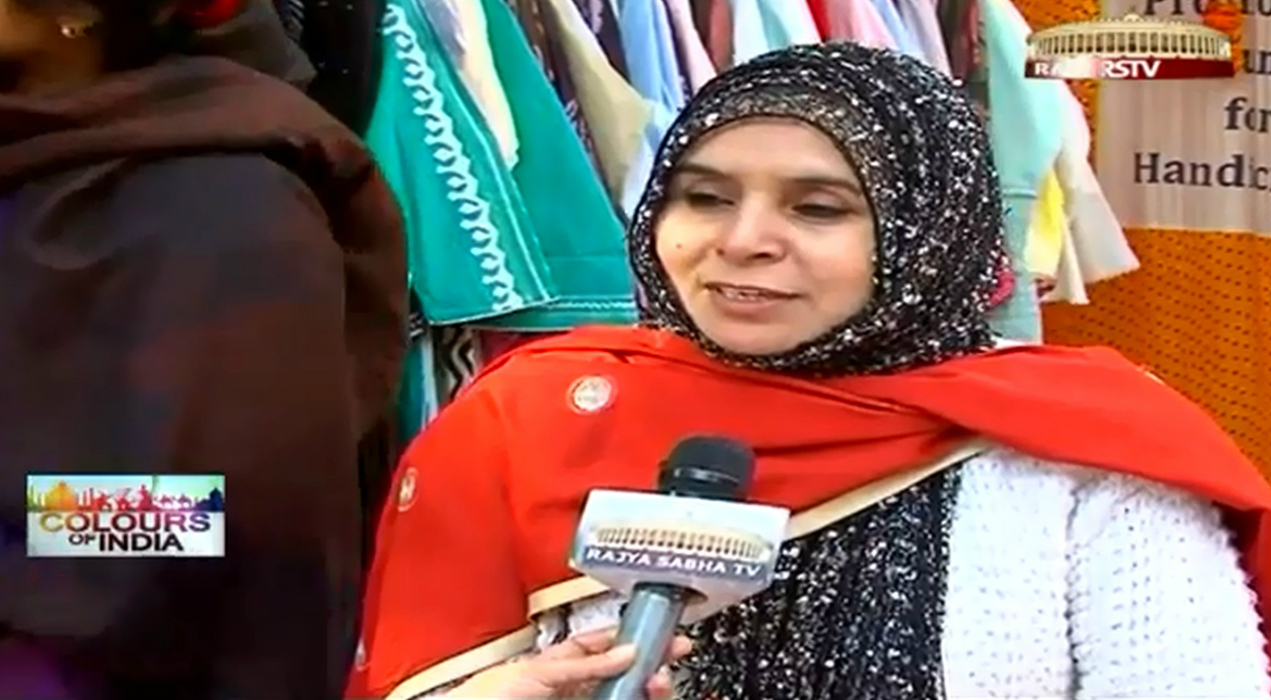
The story of Nazreen Azeez – mother of four, expert embroiderer and a Pakistani. 

Nazreen Azeez – mother of four, expert embroiderer and a Pakistani.

The Indo-Pak border issue has once again made it to the headlines. The last time something like this happened I remember reading the newspaper’s big bold white letters on an ink-black patch that said, ‘War in Kargil’. My mother stocked extra sugar and rice, because the last time India was at war, the kitchen had run out of provisions and shopkeepers sold their stock at outrageous prices. 

Today, once again, Indian TV stations are discussing everything from politics to cricket to LoC on primetime - sometimes a little too loudly. One heated discussion led to another, until my exasperated TV-viewing father-in-law declared that these guys should be taken off air for instigating a war like situation in a nation pre-divided by religion and class. And because he couldn’t possibly do that, he switched off the TV instead and a pregnant silence prevailed until bedtime. 

The next day, I showed up at Dilli Haat on official business. The Dastkari Haat Samiti which is an NGO for craftspeople was having their annual exhibition and this time around, they were collaborating with Pakistan’s Behbud Association. My story was about this collaboration. Five Pakistani women and five Indian women, sat in a circle sharing their craft techniques, styles, stories, smiles and gossip. In the past couple of days they had become fast friends. I noticed that one of them had a playful happy smile. It lingered on her face as she did went on with her daily dose of embroidery. Like she had a secret, one that was too delicious to share and too precious to hide. 

Annual Fair at Dilli Haat
I went about my business - documenting the craftswomen at work, talking to customers who examined, felt and tried on the Pakistani Salwar Suits. Meeting the organisers and going over the story with them, until finally someone introduced me to that woman with the secret smile - Nazreen Azeez. 

This was her first time in India Nazreen said, and even though she had come just a few days ago she felt welcome, like she’d just come to her maternal home. The Indian women, who sat embroidering with her, were now her friends. They all had similar stories - of homes, children, recipes and worries. But, that aside, here in India she had met her actual family, estranged during the partition. 

Yash Chopra's Indo-Pak love story
Like a Yash Chopra movie on 70mm, Nazreen’s story played out in front of my eyes. She was one of the five women chosen by Behbud Association to go on the India trip. Her husband and their four children were worried, for India was not a safe place for a Pakistani woman. Her brothers warned her against making this treacherous journey and her neighbours and friends told her that the ‘Hindu’ nation might not be too kind to her. Nazreen herself was in two minds, but her mother told her that she must go, for it was her last wish. She must go to the country that was once their home. She must climb the steps of Jama Masjid and she must bring back mud from their Karol Bagh home. So Nazreen came. Scared and alarmed by all the stories she had heard about India. Worried how people in this ‘enemy country’ might treat her, but also determined to fulfil her mother’s last wish.

Nazreen’s parents used to live in Karol Bagh. She has only heard stories about that home, for she herself was born in Pakistan. During partition, like many other Muslim families, Nazreen’s parents had made a choice. They moved to the newly formed state, while her father’s brother (Fufa-ji) decided to stay on in India. Over the years the brothers and their wives stayed in touch, first through letters, and then came the telephone and more recently skype and voice chat. The grew older, had children, who in turn married and had children of their own. Everyone spoke about Fufa-ji and his family in India like they knew them personally, but except for blurry internet images, the brothers hadn't seen each other since that fatal day many years ago.

Divided we stand

When Nazreen set off to India, her Fufa-ji’s family was informed about this journey. They now live in Ghaziabad, Uttar Pradesh about 35 kms from Dilli Haat. The day before I met Nazreen, she had had other visitors. That was her secret smile. For the first time in her life, she met her cousins!

A stitch in time
Her Indian friends and fellow embroiderers later told me that when she spun around to meet them, she took a minute to recognise them and when she did, she cried. They recognised her, and they cried too and soon all of them sitting in the circle, working on their daily dose of embroidery, cried along. Indians and Pakistanis divided by passports but united by raw human emotions and tears. 

Nazreen was given special permission to stay with her family in Ghaziabad. And so, from eight in the night to eight the next day morning she talked, wept, ate, listened, loved and laughed with her newly united family. When she returned to Dilli Haat for another day of crochet and cross-stitches, she smiled to herself in fond memory.  

Like in a dark theatre, I experienced the heart wrenching pain of separation, almost heard the silent tears as they rolled down, held my breath during the climax and sighed in relief at the happy reunion that marked the end of the story. 

Or could this be the beginning of something new and beautiful? 
Dare I dream? 
Dare we hope? 

Dare we hope?